Successful but Unfulfilled? How to Stop Living on Autopilot
You can be successful, productive, and constantly moving forward—and still feel like you're drifting. Here's how to recognize autopilot and start building your life by design.

Nobody decides to live on autopilot. It arrives quietly, in the form of a good year followed by another good year, while the questions you used to ask yourself slowly stop getting asked.
On paper, everything works. The business performs. The reputation is intact. The calendar is full. And still, somewhere around 9 p.m., there's a flatness that achievement doesn't touch.
That gap between success and fulfillment is not a motivation problem. It's a design problem.
What Living on Autopilot Actually Means
Living on autopilot means your life is being run by momentum rather than intention. Habits, obligations, and other people's urgency set the direction, and you supply the horsepower.
It rarely looks like failure. High performers are unusually good at autopilot, because competence keeps the results acceptable long after the direction has stopped being chosen.
“Drift doesn't feel like drifting. It feels like being busy.”
5 Signals You're Drifting
Your weeks blur together
You can describe your year in revenue numbers but not in moments. When the days become interchangeable, it usually means nothing is being chosen—only repeated.
You have goals for work and nowhere else
Ask a high performer for their business targets and you get specifics. Ask about health, relationships, or the next decade of their personal life and the answer turns vague.
You're reacting, not deciding
Your day is shaped by inboxes, escalations, and other people's urgency. Reaction feels productive because it is busy, but it moves you along someone else's map.
The people closest to you get what's left
Your best thinking goes to clients and your team. What comes home is the tired version. Nobody complains loudly, which is exactly why it continues.
Achievement stopped feeling like anything
You hit the number, feel about four minutes of relief, then move the target. When the wins stop registering, the problem isn't ambition—it's direction.
Why Success Stops Producing Fulfillment
Most successful people run one scoreboard: work. Revenue, titles, growth, output. It's measurable, it's rewarded, and it produces feedback quickly.
Fulfillment runs on a wider set of books—health, relationships, purpose, wealth, recreation, and personal growth. Optimize one column hard enough and the others quietly go unfunded. Nothing collapses. It just gets thinner.
That's the whole argument behind Successfully Mediocre: you can be excellent at your work and average at your life, and the world will keep applauding either way.
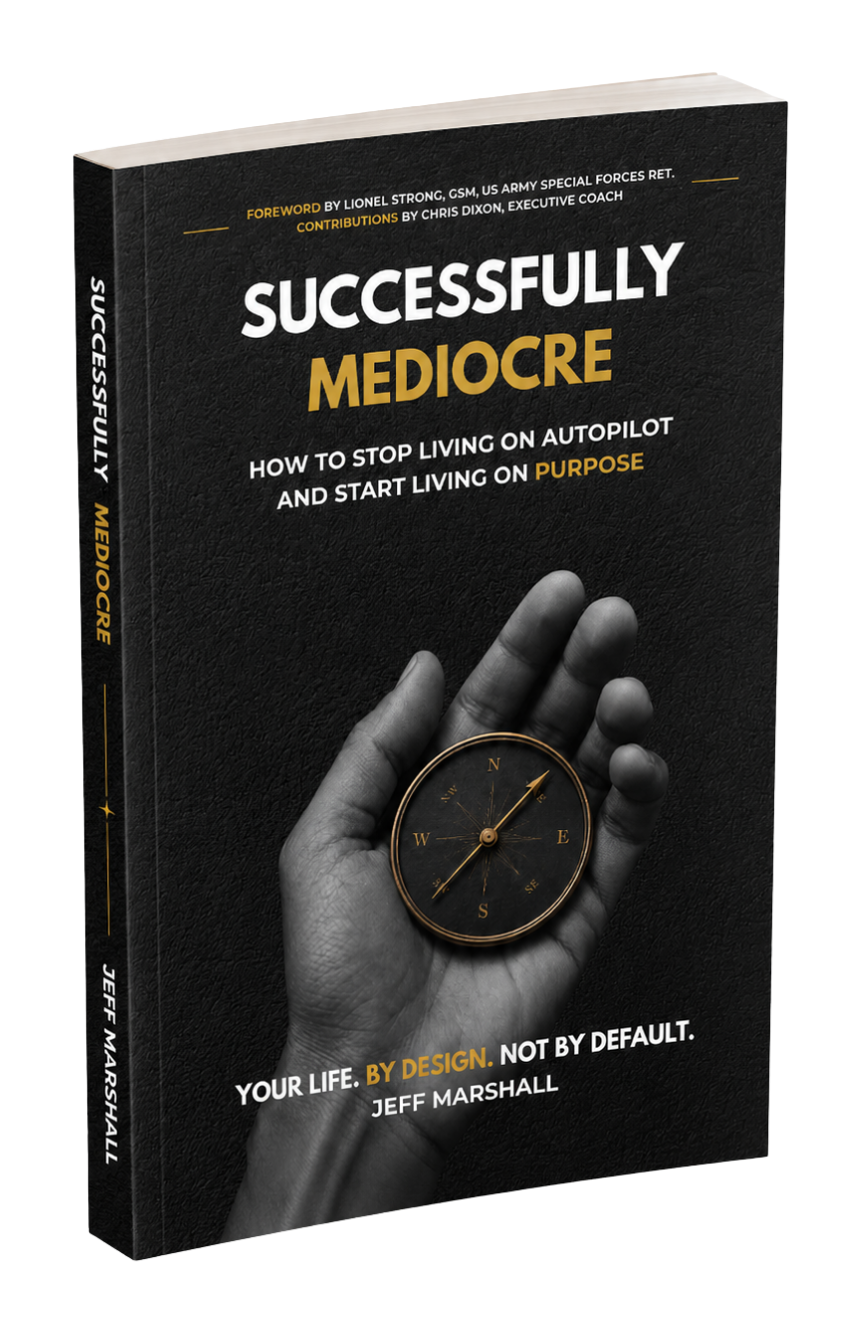
Successful on Paper. Drifting in Person?
Successfully Mediocre introduces the RISE Operating System for high performers who want to stop living on autopilot and start living on purpose.
How to Stop Living on Autopilot
You don't fix drift with a better morning routine. You fix it by running your life with the same rigor you already apply to your business: an honest audit, a defined destination, a strategy, and a rhythm of execution.
That's the RISE Operating System—four stages applied across every domain of your life, not just work.
Where are you actually?
A structured audit of every domain of your life, so drift gets named instead of tolerated for another five years.
Where do you want to go?
Define what good looks like in health, relationships, wealth, work, and everything else you say matters.
How will you get there?
Turn intentions into targets, milestones, habits, and boundaries you can actually run each week.
Build the rhythm.
Calendar, routines, weekly reviews, and accountability—the machinery that keeps a plan alive after motivation fades.
“The goal isn't a perfect life. It's a life you actually chose.”
Start with the free RISE resources and life assessment. If you want the system installed with support, that's exactly what the 12-Week Install is built for—and teams and organizations can run it together.
What to Do This Week
Block ninety minutes. Write down where you honestly stand in each domain of your life, then write one sentence describing what you want that domain to look like in three years. The gaps you find are your real plan.
Then pick one gap and put a recurring block on next week's calendar to close it. Intention that never reaches the calendar is just a mood.
Frequently Asked Questions

Work-Life Balance Is the Wrong Goal: What Founders Need Instead
Founders are constantly told to balance work and life. But treating them as competing priorities may be the problem. Explore a more intentional approach built around integration and alignment.
Read Article →
Founder Burnout: 9 Signs Your Business Is Growing but Your Life Is Shrinking
Your company may be growing while your health, relationships, energy, and freedom quietly decline. Learn how to recognize founder burnout before success starts costing more than it gives you.
Read Article →Stop Living by Default. Start Living by Design.
You already know how to run something well. Point that same skill at your own life and the next level stops costing you the rest of it.